



Description
| Topic | Details |
| Purpose / Target Users | It is used particularly when individuals (children or adults) may have difficulty recognising orientation (vertical/horizontal/tilt) of lines, for example in cases of brain lesions or visual-perceptual disorders. The LEA Mailbox Game is designed for assessment of visual perception of line/slot orientation rather than standard visual acuity. Target users include paediatric patients, older adults, or individuals with suspected dorsal (parietal) or ventral (temporal) stream dysfunction in the visual/perceptual pathways. The game format (cards + slot) makes it suitable for children (engaging, interactive) and clinicians who need a more playful/perceptual test rather than a strict acuity chart. |
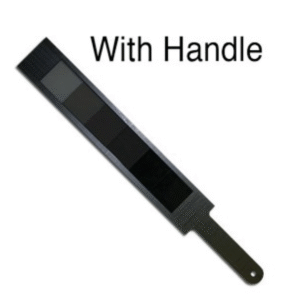
| Optotypes / Symbols | This device does not use optotypes (letters, symbols) like a typical visual acuity chart. The “symbols” here are the log-unit values (0.3, 0.6, 0.9, 1.2, 1.5, 1.8) engraved on each filter element of the bar. The clinician uses these values to determine the amount of filter density required to equalise pupil response between the two eyes. |
| Scaling / Spacing | Scaling: The filter densities increase in a standard log unit progression (0.3 → 0.6 → 0.9 → 1.2 → 1.5 → 1.8). This progression corresponds to increasing attenuation of light and allows quantification of the severity of the afferent defect. Spacing: There is no “spacing between lines” as in a visual acuity chart. Instead the filters are set side by side on a bar; each filter block is a fixed size (see physical dimensions below) and the filters are ordered in increasing density. |
| Range of Acuity / Line Sizes | Since this is not a visual‐acuity chart, the typical “acuity range / line sizes” don’t apply. Instead, the “range” is the filter densities: from 0.3 log units (lightest) through to 1.8 log units (heaviest). The clinician finds which filter density is needed to equalize pupillary responses. One might interpret the density value as the “magnitude” of the afferent defect: higher density required → greater defect. |
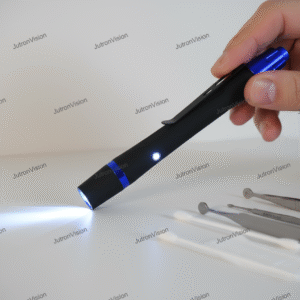
| Testing Distance | There is no fixed testing distance in meters/feet as for a vision-chart. The device is used during a swinging flashlight test (or alternating light test) at typical near/eye-examination distance (the clinician holds a penlight ~30-60 cm from the eyes). The filter bar is held over one eye while the light is alternated between eyes. So you don’t need a dedicated “6 m room” etc. Just normal clinical pupillary test set-up. |
| Physical Size & Dimensions | For the Small / Pocket version the manufacturer states: Overall bar size: 6.5″ × 1″ (≈ 16.5 cm × 2.5 cm) or 16.5 cm long and ~3 cm wide. Each filter block measures 7/8″ by 1″ (≈ 2.5 cm × 3 cm) on this small version. Material: compact size intended to fit in a shirt pocket (“Fits in shirt pockets”) and comes with a slipcover. |
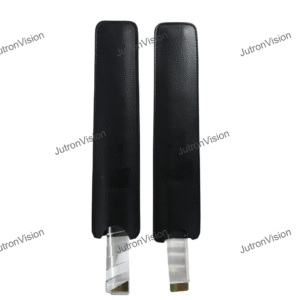
| Mounting / Display Features | Mounting/Display: This is a hand-held bar, not wall mounted or permanently displayed. The clinician holds it in front of one eye of the patient while performing the pupillary test. Display Features: The bar has engraved log unit values on each filter section, enabling easy reading of which density is in use. Extras: Comes with a leather slipcover (for the small version) for protection and portability. |
| Included Accessories / Extras | Included accessories for the small version: Leather slip-cover/pouch (to protect the bar when carried) for the pocket version. Instructions for use (either shipped with or available online) refer to how to perform the pupillary test and cleaning instructions. No additional complex accessories (e.g., lights, frames) as the bar is just the filter bar itself. Optional: Some larger versions may include case, handle, etc (but small version is pocket size without large handle) per manufacturer. |
| Durability / Material Qualities | The instructions for reuse (for the large version, which likely apply similarly to the small bar) indicate: Reusable device — store in ambient temperature, no special environment. Clean with mild soap and water; never use alcohol, which can haze the bar. The bar is manufactured by Good-Lite, established manufacturer for vision-testing equipment — that is a marker of quality. Material: The filters are optical grade neutral density filters, probably set in a structural bar; though exact substrate is not fully specified, the manufacturer refers to neutral density filter blocks of known log values. Construction: For small version, compact size and slip-cover suggest portability and moderate protection; however as with any optical device care must be taken to avoid scratches or light-leaks around filter edges. The large version instructions caution to “keep pressed up and fully covering the eye to prevent light leaks” when density is high. |
| Usability | Highly portable — the small bar fits in a shirt pocket; this supports clinician workflows in clinics, mobile screening, field use. Engraved log values make selection of density straightforward. The incremental log densities allow quantification (not just yes/no) of severity. |
| Marker of Quality | The manufacturer is Good-Lite, a long-standing brand in eye-care instrumentation since ~1930. The bar uses standard log‐unit densities (0.3 → 1.8) which is consistent with clinical standards for RAPD quantification. The presence of an instruction-for-use (IFU) document, durability/cleaning guidelines, and slip-cover all point to a professional medical-grade device rather than a generic optical toy. |
| Potential Limitations / Checklist | Because it is compact, the filter blocks are smaller (2.5 cm × 3 cm) compared to the large version’s 38 mm square. For patients with large pupils or under bright adaptation the smaller filter size might allow stray light. The clinician must ensure proper seal of the filter over the eye and avoid light-leaks; the instructions for large version mention special caution at high densities. As good practice, the small version should be used similarly. While the small version is portable, extra care may be needed for durability (scratches, drop) given its smaller size. |
Reviews
There are no reviews yet.