



Description
Product description
- The Farnsworth 100 Hue Color Test is a gold-standard color vision assessment designed to measure fine hue discrimination across the full visible spectrum. The test requires the patient to arrange multiple colored caps in precise hue order, and the resulting error pattern helps clinicians identify the type, axis, and severity of color vision deficiency, as well as detect subtle or acquired color vision changes that simpler screening tests may miss. Because of its sensitivity, it is widely used in ophthalmology, optometry, occupational health, and research settings.
- What it measures: Fine hue discrimination across the entire color spectrum
- How it works: Patient arranges colored caps in correct sequence; errors are analyzed for pattern and severity
- What it detects: Congenital and acquired color vision deficiencies, including subtle losses
- Clinical value: Highly sensitive—ideal for monitoring progression or recovery over time
- Common uses: Detailed clinical evaluation, occupational vision standards, drug/toxicity monitoring, research studies
- Result output: Generates a Total Error Score (TES) and characteristic error axes
- Testing requirements: Requires standardized daylight-equivalent illumination and careful administration
- Care: Protect caps from fading and scratches; avoid heat and sunlight; store securely after use
| Topic | Details |
| Purpose / Target Users | • This is a diagnostic/arrangement test of hue discrimination — it measures how finely a person can distinguish between small hue (colour) differences. • It is used in clinical and vocational settings where accurate colour vision/hue discrimination is required (e.g., textile, printing, paint & coatings, colour-critical industries) and for diagnosing or classifying colour vision ability (not just simple red/green screening). • Not typically a simple screening test like an Ishihara plate; more detailed/discriminative. |
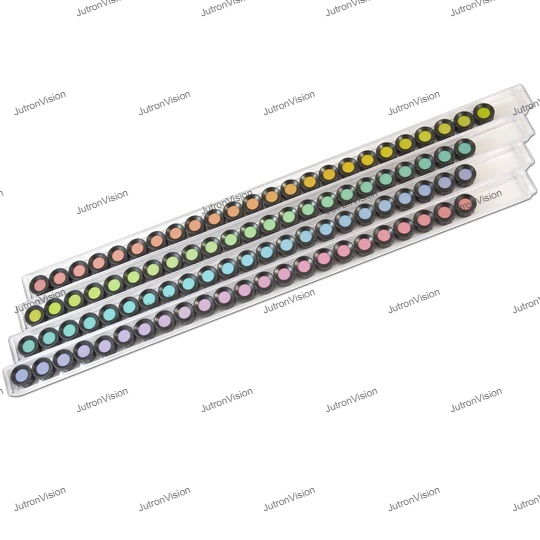
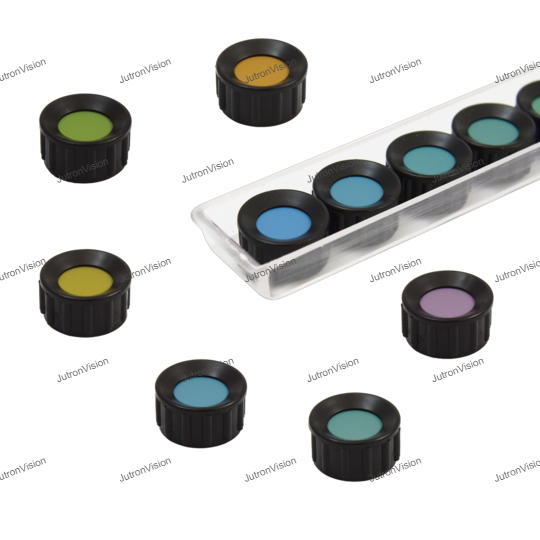
| Optotypes / Symbols | • Instead of “letters” or “symbols”, the test uses colour discs: 93 individual coloured discs in four trays/rows. • The discs are arranged by the test-subject into a sequence of hues between fixed anchor discs (at each end of each row) — so the “task” is arranging hue-gradations correctly. |
| Scaling / Spacing | • The discs are uniformly sized (in the physical version ~7/16″ / ~11 mm diameter in some literature) when originally produced. The spacing: they lie in trays such that the subject can move each disc to follow the hue gradient; the rows cover the full hue circle. |
| Range of Acuity / Line Sizes | This is not a visual acuity (sharpness) test (i.e., you are not reading letters of different sizes) so “line sizes” in the sense of Snellen letters don’t apply. Rather it measures hue discrimination sensitivity (how small a hue change distinguishable).Because the discs are typically around ~11 mm diameter (7/16″) and placed close together, the test subtends a modest visual field at typical viewing distance (e.g., ~50–60 cm). The literature doesn’t specify “line sizes” like acuity tests.• The reference literature emphasises error score: number of misplacements and magnitude of misplacements (distance from correct position) rather than “acuity” in mm. |
| Testing Distance | The manufacturer guide doesn’t always state a fixed distance in the public specification, but best practice is to have a comfortable working distance where discs are visible clearly but not too close to distort hue perception.The guide emphasises stable illumination (approx. 25 foot-candles or greater, or daylight equivalent ~6,280°K) and consistent background black tray. Many clinical setups use ~50–60 cm (20–24 inches) viewing distance for similar hue tests but you should check local protocol. |
| Physical Size & Dimensions | • Dimensions: 56 cm × 17 cm × 2.4 cm (22.05″ × 6.7″ × 0.9″) for the kit (including tray & cases) per Good-Lite listing. • Contains 4 clear acrylic (ABS) boxes holding the colour disc sets, mounted in a black tray/lid. |
| Mounting / Display Features | • The discs are placed in clear acrylic boxes so that the patient’s sequence can be preserved (reducing disruption) while scoring. • The black tray background is recommended so that surrounding colours do not influence hue discrimination. • No electronic display built in; scoring is manual using template + optionally Excel-scoring template (CD provided). |
| Included Accessories / Extras | • The kit includes: 93 colour discs, four clear acrylic boxes, a black tray + lid, scoring template (laminated) for copying, instructions. • The Good-Lite catalogue states also: supply of non-latex, lightly powdered gloves for the patient to avoid fingerprints or smudges on discs. • A CD with Excel scoring template is also included in some versions. |
| Durability / Material Qualities | • The housing is clear acrylic / ABS plastic boxes: robust, protects discs. Specification indicates “clear acrylic containers … reduce potential for test disruption by holding the patient’s disc sequence intact.” • The colour discs themselves must be protected from direct finger contact (the guide states: “Each color disc is mounted without any protection … it is very important that no one touches the color sample to avoid the damage of fingerprints.”) • The guide recommends storage in a cool, dry place, and keeping the kit wrapped to protect from light exposure, as discs may fade or be affected by light. |
| Usability / Marker of Quality | • Generally considered a high-quality, professional colour discrimination test; user (examiner) must ensure proper lighting, background, viewing distance, and that the subject understands the instructions. • Because the discs are small and hue differences subtle, good ambient lighting and minimal glare are needed.• The kit’s design with clear boxes/tray helps maintain sequence and scoring. The scoring involves entering the sequence into template, computing error score, graphically showing error distribution — this adds usability for analysis. • That said, it is more time-consuming than quick screening tests (e.g., Ishihara) so may be less suitable for high-throughput screenings unless colour discrimination is the focus. |
Reviews
There are no reviews yet.