



Description
Product description
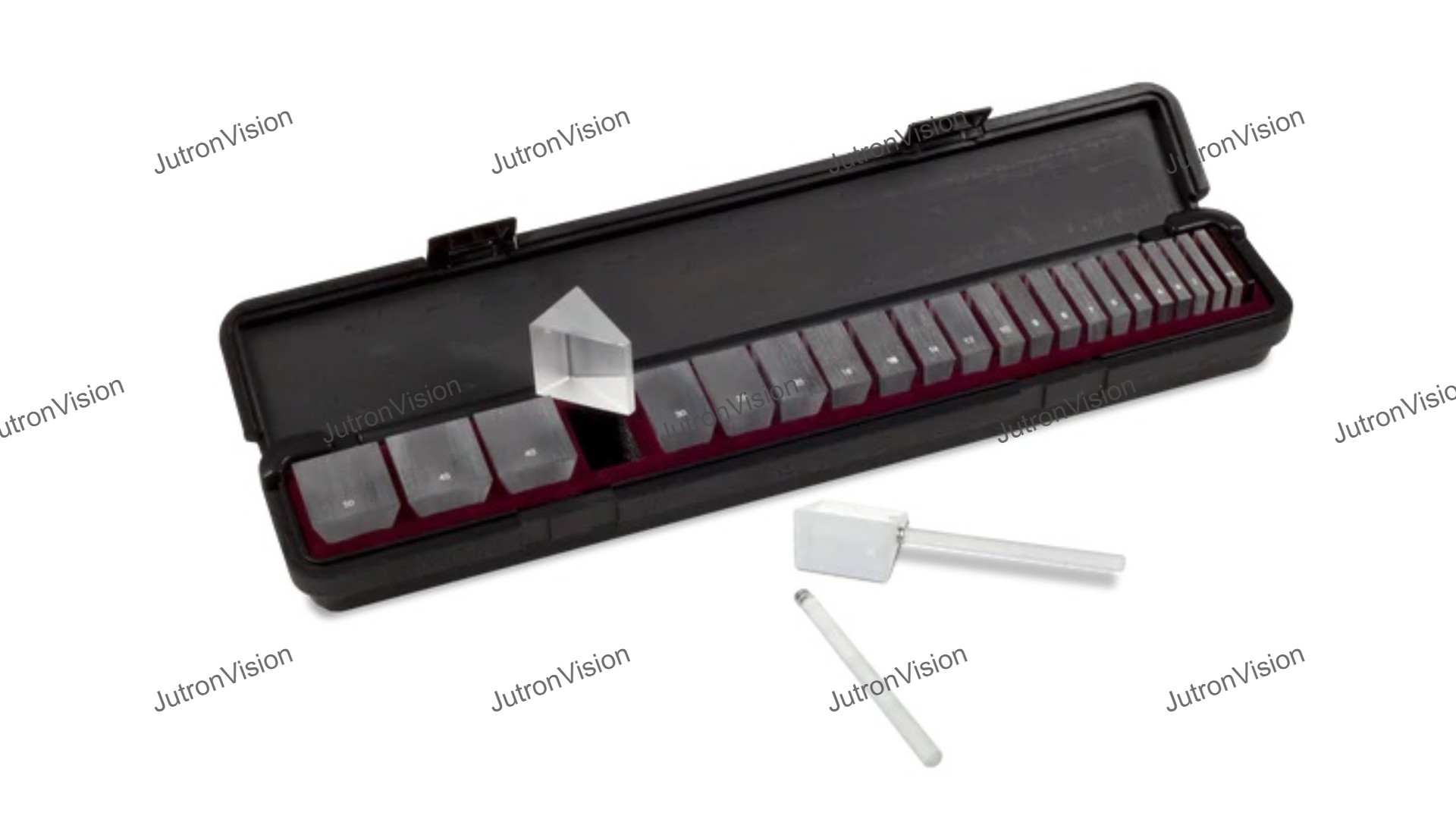
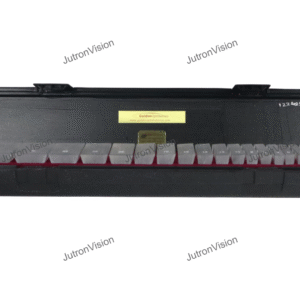
- The Prism Set with Magnetic Handle (22 pcs) is a calibrated, clinic-ready kit for fast, precise measurement and training of ocular alignment. Snap a prism onto the magnetic quick-swap handle and move seamlessly through cover/alternate-cover neutralization, quantify horizontal (BI/BO) and vertical (BU/BD) deviations, or probe fusional reserves—all while keeping base orientation stable and exam flow smooth at the chair, slit lamp, or with a trial frame.
- What it’s for: Cover/alternate-cover neutralization, measuring phoria/tropia (horizontal & vertical), and checking fusional reserves
- Why magnetic matters: One-hand quick swap with secure alignment → fewer handling errors and faster, cleaner endpoints
- Set composition: 22 calibrated prisms spanning low→high powers for fine steps and larger shifts; clear diopter & base markings
- Where it works: Chairside, slit lamp, or mounted in trial frames; reliable for pediatrics and adults
- VT applications: Convergence/divergence drills, vertical compensation, documenting break/recovery and CPM with other tools
- Workflow tips: Keep apex-to-base orientation correct, center over the visual axis, and record distance/near test conditions
- Care & durability: Wipe optical faces with lens-safe solution; avoid touching faces; store in the lined case to protect calibration and coatings
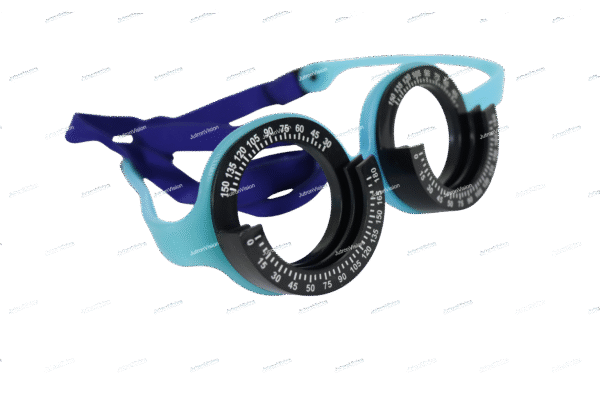
- Compatibility: Plays well with occluders, fixation sticks, Brock string warm-ups, and reduced-aperture trial lenses for steadier reflexes
| Topic | Details |
| Purpose / Target Users | Purpose: This prism set is designed for measurement of ocular deviations (strabismus, heterophorias) and for use in binocular vision assessment and vision-therapy applications. For example, one listing says: “These high-quality prisms are used to measure the deviation in strabismus.” Target Users: Ophthalmologists, optometrists, orthoptists, vision-therapy professionals, and eye-care clinics or hospitals. Essentially clinicians who need to quantify prism diopter amounts or use prisms during examination or therapy. |
| Optotypes / Symbols | In this device context, “optotypes / symbols” do not refer to letters or symbols as in acuity charts. Instead, each prism block is labelled by its diopter value (e.g., ½ Δ, 1 Δ, 2 Δ, up to 50 Δ) and possibly direction (base-in, base-out) though the set may not include direction markers depending on variant. The listing states: “22 Piece Prism Set includes: ½, 1, 2, 3, 4, 5, 6, 7, 8, 9, 10, 12, 14, 16, 18, 20, 25, 30, 35, 40, 45, and 50 diopter plus Red Lens.” Thus, the “symbol” is effectively the number (value) etched/marked on each prism. |
| Scaling / Spacing | Scaling: The progression of prism strengths is: ½ Δ, 1 Δ, 2 Δ, 3 Δ, 4 Δ, 5 Δ, 6 Δ, 7 Δ, 8 Δ, 9 Δ, 10 Δ, 12 Δ, 14 Δ, 16 Δ, 18 Δ, 20 Δ, 25 Δ, 30 Δ, 35 Δ, 40 Δ, 45 Δ, 50 Δ. Spacing: The physical prism blocks measure approximately 37 mm square each. There is no “line spacing” as in vision charts; each prism is an individual block and is selected/placed as needed. |
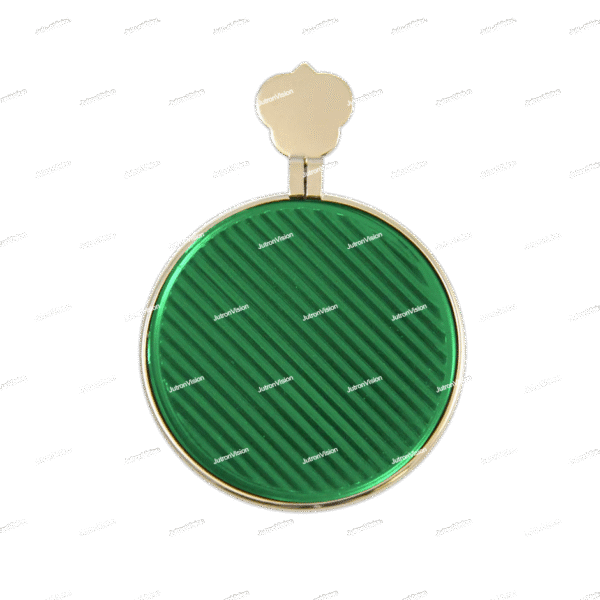
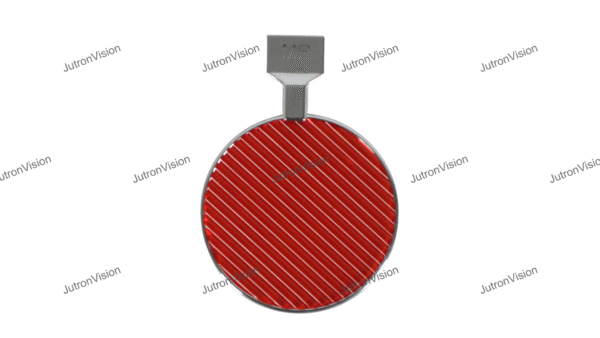
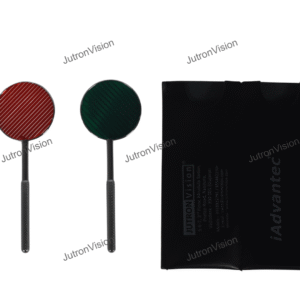
| Range of Acuity / Line Sizes | Because this product is not an acuity chart, “range of acuity / line sizes” is not directly applicable. Instead, the key measurement range is the prism diopter strengths from ½ Δ up to 50 Δ. That defines how large a deviation the set can measure or treat. The inclusion of a “Red Lens” in the set is additional and likely used for red-filter testing rather than prism measurement (common in binocular vision assessment). |
| Testing Distance | There is no fixed “testing distance” rule tied to this set (unlike e.g. a 6 m acuity chart). Clinicians will use these prisms at various distances depending on protocol (near, far, binocular vision tests). The prisms are placed in front of the patient’s eye (or in front of a target) and the patient views a target at the relevant test distance. The important factor is matching the prism diopter and base direction to the patient’s deviation—not the exact distance of use. |
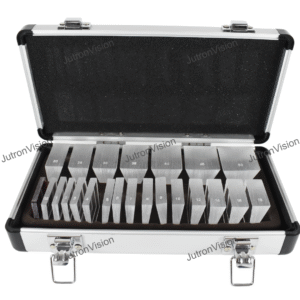
| Physical Size & Dimensions | Prism block size: Approximately 37 mm × 37 mm square each. Case and set: The set comes in a foam-lined hard plastic case for protection and organisation. Magnetic handle: The set includes magnetically attachable handles that attach to the prisms (for presentation or manipulation) using strong rare-earth magnets. The listing: “magnetically attachable handles … Strong rare-earth magnets hold the devices firmly on the handles.” The listing does not provide overall external dimensions of the case; but given 22 blocks ~37 mm square, the internal footprint is likely around ~250 mm × ~100-120 mm approximate (just an estimate). |
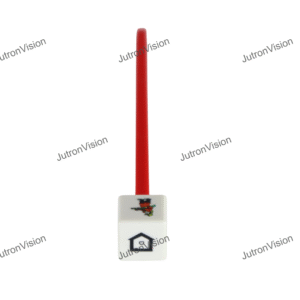
| Mounting / Display Features | The prisms are loose blocks (not permanently mounted) and used individually in testing or therapy. The magnetic handle allows a prism to be attached for easier handling/presentation, or to transform the block into a “stick-mounted” prism temporarily. This increases usability. No wall-mount or display board is specified; the case is portable and designed to sit on a countertop or shelf. The hard plastic case with foam lining secures the blocks and prevents damage during storage/transport. |
| Included Accessories / Extras | Set includes: 22 prism blocks of specified diopters plus a Red Lens. Two (at least) magnetic handles are included (the listing mentions “two magnetic stick handles”). Foam-lined hard plastic storage case. Likely instructions or a spec sheet, though not always detailed in the listing. The fact that the magnetic handles are detachable means the set can be used either as loose blocks (for storage) or as “handle-mounted” prisms for examination/presentation. |
| Durability / Material Qualities | The manufacturers indicate that prisms are made of high-quality plastic or optical material with minimal birefringence (important for polarized testing). For example: “These high-quality prisms … it is important to conduct polarized testing through prisms that are known to cause the least interference with polarization.” Block size and casing protect the prisms from damage; the foam-lined case helps avoid scratches and maintains alignment/condition. Magnetic handle attachments use rare-earth magnets which should maintain strong holding force and easy detachability—good for repeated use. Users must handle the prism surfaces carefully (cleaning, avoiding scratches). The listing for another variant mentions that stick-mounted prisms “stay cleaner and avoid fingerprints compared to the square prisms … the less often they need to be cleaned, the longer they will last.” The blocks appear to be consistent in size (37 mm square) which helps ensure standardisation. |
| Usability / Marker of Quality | Usability: The magnetic handle design is a usability enhancement: convenient to attach/detach, easier manipulation in exam settings. The broad range of diopters (½ Δ to 50 Δ) covers many clinical scenarios of ocular deviation measurement. The foam-lined case enhances portability and protection—suitable for busy clinics. Markers of Quality: Made by recognised manufacturer (Good-Lite) with a long history in vision-testing equipment. Clear listing of diopter values and uniform block size (37 mm) which suggests precision and standardisation. The explicit mention of “designed for polarized testing with the least interference” points to attention to optical quality. Inclusion of accessories (magnetic handles, protective case) indicates a professional set rather than a basic accessory. The catalog listing highlights the set as “S-22 Magnetic Stick Prism Set … made of high-quality plastic … hard molded case”. Things to inspect / ensure: When purchasing, verify that the prism surfaces are defect-free (scratches, chips), that the magnetic handles have good retention, and that the case holds blocks snugly to avoid movement or damage. If your practice uses polarized tests (Stereo tests, polarised lenses), confirm the prisms are compatible with polarisation (manufacturer statement says “least interference with polarization”). Confirm warranty/support and calibration/maintenance guidelines (though prism blocks normally don’t “calibrate”, one should check for signs of damage over time). |
Reviews
There are no reviews yet.