



Description
Product description
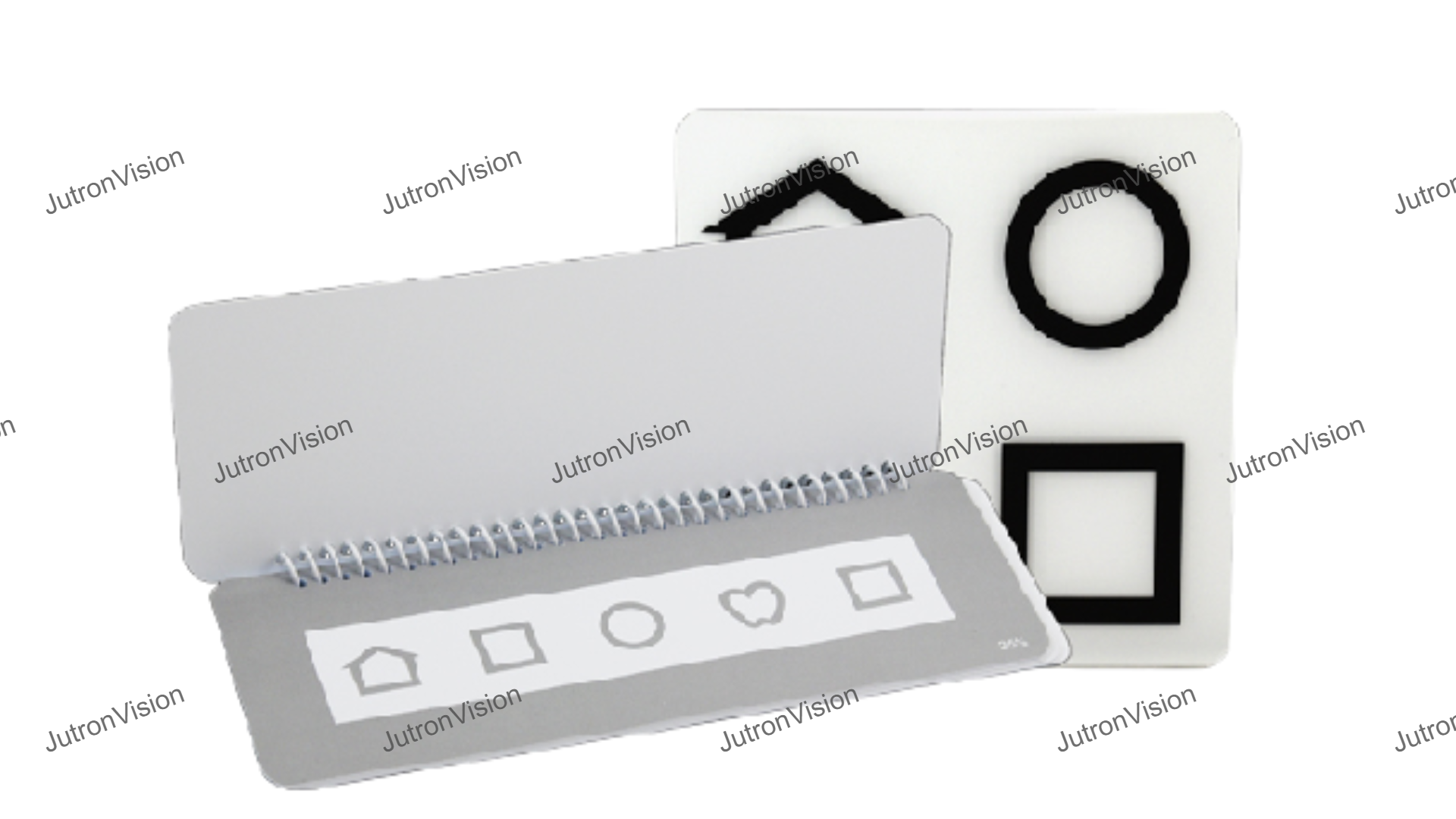
- The LEA SYMBOLS® Low Contrast Test – 10M Flip Chart is a pediatric-friendly tool for assessing low-contrast visual acuity/contrast sensitivity, using the familiar LEA symbols so children can respond by matching or naming even if they can’t read letters. Unlike standard black-on-white charts, it presents symbols at reduced contrast levels, helping clinicians identify functional vision deficits that can affect real-world tasks like seeing faces, steps, whiteboard text, or low-light details—even when high-contrast acuity appears normal. The 10-meter flip chart format makes it quick to administer and easy to repeat for monitoring conditions and treatment outcomes.
- What it measures: Low-contrast acuity / contrast sensitivity using standardized LEA optotypes
- Why it matters: Detects “hidden” visual issues that high-contrast charts can miss; relevant for daily function and school performance
- Child-friendly response: Works well for pre-literate kids via matching cards or simple naming
- 10-meter format: Designed for consistent distance testing with easy page flips and standardized presentation
- Clinical uses: Pediatric screening, amblyopia follow-up, neuro-visual/retinal/optic nerve monitoring, post-treatment tracking
- How it’s used: Standardize lighting and distance → test each eye separately → present decreasing contrast levels → record lowest contrast level achieved
- Best practices: Use controlled illumination, minimize glare, maintain consistent test distance/time to ensure repeatability
- Care: Protect pages from fading/soiling, store closed and flat, and wipe gently as needed without damaging print contrast
| Topic | Details |
| Purpose / Target Users | Purpose: This test is designed to measure low-contrast visual acuity, i.e., the ability of a patient’s visual system to recognise symbols when the contrast between symbol and background is reduced. In many cases high-contrast acuity (standard charts) may appear normal, but low-contrast acuity reveals functional visual deficits, especially in low-light or low-contrast conditions. For example, the manufacturer states: “Test for quick measurement of low contrast visual acuity at 25%, 10%, 5%, 2.5%, and 1.25% contrast by measuring the distance where the symbols are seen.” Target Users: Optometrists, ophthalmologists, vision-therapists, low‐vision specialists who want to test contrast sensitivity or low-contrast acuity in children or adults. Particularly useful in paediatrics (since LEA Symbols are familiar shapes) and for patients whose standard acuity is normal yet visual complaints persist (e.g., mild visual impairment, early disease, neurologic/rehab cases). Clinics or screening programmes where contrast sensitivity is part of functional vision assessment (for example, in low‐vision or neurologic rehab settings). Indeed, the Indian “Resource Manual” states the “Lea Symbol Low Contrast 10M Flip chart” is for contrast sensitivity testing especially low and intermediate contrast levels — important for children |
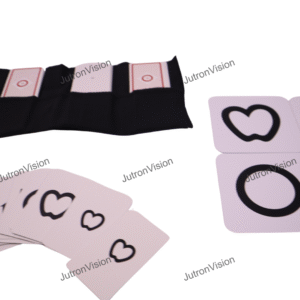
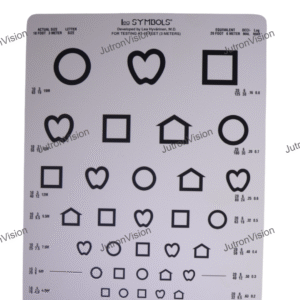
| Optotypes / Symbols | The flip chart uses LEA SYMBOLS® (i.e., the familiar apple, house, circle, square) rather than standard letters. This is especially suitable for children or those who may not recognise letters. For example the variant “LEA Symbols Low Contrast Test 10M” uses the symbols format. The symbols are presented at fixed size for the “10 M” level (so the same symbol size across pages) but the contrast of the symbols changes (25%, 10%, 5%, 2.5%, 1.25%). The chart also includes a response key, recording forms and instructions. |
| Scaling / Spacing | Scaling: The symbols are sized for “10 M” level: i.e., the symbol size is such that if viewed at 10 m, they correspond to a visual acuity of 1.0 (20/20) at high contrast. The manufacturer explains: “10 M symbols correspond to visual acuity 0.10 at 1 m, 0.05 at 0.5 m and 0.3 at 3 m.” Spacing: While explicit spacing of the symbols/lines is not widely published, one source (the Indian resource manual) states that for this test: “Each page should have 5 symbols; … proportionally spaced between the optotypes; … optotype size remaining the same but contrast varying.” Therefore you should check with the supplier that the spacing between the symbols is correct (proportional spacing) and that the symbol size is consistent across different contrast levels so that only contrast changes, not symbol size. |
| Range of Acuity / Line Sizes | Because this is a single‐size symbol low contrast test (10 M level), the range of acuity is implicit rather than explicitly broken into many line sizes. Essentially: symbols of size 10 M, different contrast levels allow you to see at what distance the patient can recognise them → you can then convert to visual acuity equivalents. For example, the specification states that the chart includes a table for conversion to Snellen equivalent VA values. If you need a test with multiple line sizes (e.g., 20/200 to 20/10) at low contrast, you may need the “ETDRS‐style low contrast charts” rather than the single‐size 10 M flip chart. |
| Testing Distance | The flip chart is designed for use at 10 feet / 3 metres (10 ft ≈ 3 m) distance. For instance one spec: “10 M symbols correspond to visual acuity 0.10 at 1 m … 0.3 at 3 m.” The Indian resource manual for equipment lists it under a 10 ft/3 m condition. So in your clinic you should ensure you have at least ~3 m clear distance (or scaled accordingly) between chart and patient when doing the test. If you don’t have full 3 m room, you might scale proportionally (but then you must adjust the conversion table accordingly). The test may include a table to compute Snellen equivalent for different distances. |
| Physical Size & Dimensions | Dimensions: According to the manufacturer: 3.25″ × 9″ (8.25 cm × 22.9 cm) for each “page” or chart size. For example the flip chart is described as “6 pages, 3.25″ x 9″ (8.25 cm x 22.9 cm).” The flip book size means it is fairly portable/hand‐held. Because it is a “flip chart” (pages offset for easy flipping), you’ll want to check: number of pages (6 pages for this product), binding quality, page material thickness. One listing: “6 pages” for LEA Symbols version. In terms of mounting/display: The small size means you might hold it in hand or place on small stand rather than large wall chart. |
| Mounting / Display Features | The flip chart is designed as a handheld or table/stand chart rather than a large wall chart. Because it is small (8.25 cm × 22.9 cm), you can easily hold or rest it on a table or stand. Pages are “offset for easy flipping” – makes changing contrast levels quick. The product includes a response key, instructions and recording forms, which helps in clinical documentation. It does not appear to include a full stand or wall mount as part of the standard product. If you prefer wall mount use, you may have to supply or check with supplier whether mounting bracket is available. Because the chart is small, ambient lighting and contrast of room may influence results more than for large wall charts – you should ensure good lighting and no glare. |
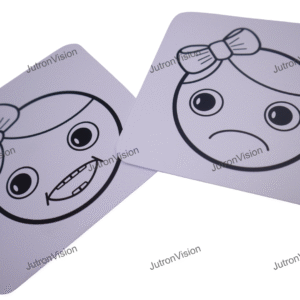
| Included Accessories / Extras | Included items: For the LEA Symbols Low Contrast Test 10M Flip Chart the packaging includes: response key, recording forms, instructions. It may also include training cards (for demonstration or familiarisation) in some versions. For example one description says “Test includes … training cards, recording forms and instructions.” No major extras such as stand, clip‐on, etc are explicitly listed in the publicly available spec for this flip chart. If you want extras (e.g., carry case, larger size version, scrambled version for repeat testing) you may need to purchase those separately. For example, there is a “Scrambled Order” variant (Mixed Order) of the flip chart. You might also need suitable stand/clip and ambient lighting calibration equipment depending on your clinic environment. |
| Durability / Material Qualities | As per the resource manual from India: The chart should be “made of HDPE [high density polyethylene] or any other non-tear water proof material” when used in school/field screening contexts. For the Low Contrast Flip Chart: the specification lists that material requirement. The manufacturer describes it as a flip book of pages — presumably laminated or printed on durable cardstock/paper – the exact material is not detailed publicly for this product, but you should verify that the pages are sturdy enough for repeated use in clinic or screening settings (resistant to tearing, moisture, fading of printing). The contrast levels (25%, 10%, 5%, etc) mean that printing precision (correct contrast, accurate symbol form, uniform background) is crucial — check that the product from your supplier is genuine and from the manufacturer (e.g., Good-Lite / LEA Test International) to ensure print quality and accuracy. Because it’s used in clinic or screening, durability is important: many flips (pages) may be turned, possibly by many staff or in screening camps, so binding quality, lamination (if any), should be high. |
| Usability | The flip chart is small and handheld — making it convenient in small rooms or portable screening contexts (e.g., school screening, outreach). The flip mechanism (offset pages) allows quick switching of contrast levels, which enhances clinical workflow. The use of LEA Symbols (rather than letters) makes it usable for children, people who may not know English letters, and patients with limited literacy. The manufacturer provides a table for conversion of distances/VA values, which aids interpretation of results. The product includes response key and recording forms which helps in documentation and tracking over time. Because the symbol size is fixed (10 M) but contrast varies, the test is simple: you move the patient back or forward until they can recognise the symbols – easy to interpret. |
| Marker of Quality | The print specification of multiple contrast levels (25%, 10%, 5%, 2.5%, 1.25%) indicates that the product is designed for precision testing of low contrast acuity, not a generic low‐cost chart. Small size does not compromise clinical utility; specification includes chart size and conversion table, indicating good documentation. Material specification (HDPE or similarly durable material) for screening use suggests good build quality when the specification lists it. (Though you must verify your procured unit meets that). CE-mark status (one listing says CE approved) is positive. The availability of “scrambled” order version (to avoid memorize) is a mark of higher quality (for repeated testing). If the supplier provides calibrations or head-to-head accuracy with other standardized tests, that also indicates quality. |
Reviews
There are no reviews yet.